
Comedy writer Brett Forrester explains how he wrote a classic episode of a classic show, and offers a peek into how a writers room works.
Brent Forrester has been a writer on The Simpsons, The Office, The Ben Stiller Show, King of the Hill, Late Night With Conan, and Mr. Show. Here, he explains how he wrote a classic episode of The Simpsons, ‘Lemon of Troy’.
Along the way, Brett shares the inner workings of a typical comedy show’s writers room, and the career paths that lead to and from moments like the writing of this episode. He also explains his use of setup & payoff in this episode, and how he took inspiration from Homer’s The Odyssey, Mark Twain’s Tom Sawyer, and his own childhood nostalgia:
Disguise the Contrivance
Brett’s approach to crafting a satisfying conclusion is to start at the end, and reverse-engineer the sharing of information throughout the episode (the setups) that will make the ending (the payoff) land effectively.
The Set Piece
In particular, Brent explains the ‘set piece’: a mini-story within each episode of The Simpsons; essentially, the comedy retention hook. Brett describes the set piece as “an extended comedy bit”, usually at the start of an episode, but sometimes, as in ‘Lemon of Troy’, also within the episode.
One significant revelation, at least for me, is that the opening set piece, which is usually unrelated to the rest of the episode, was also written by the same episode’s writer. I’d always assumed that the openers came from a separate bank of ideas, and were assigned to episodes as needed… but in effect, these writers were pitching 1.5 episodes per session. Wow.
Sidenote – Brett mentions one example of a mid-episode set piece, the meat industry short film, which contains one of my all-time fave gags:

Further Viewing
Fellow Simpsons writer John Swartzwelder shares his trick for making writing easier (in his interview with New Yorker, via Brendan McDonald)…
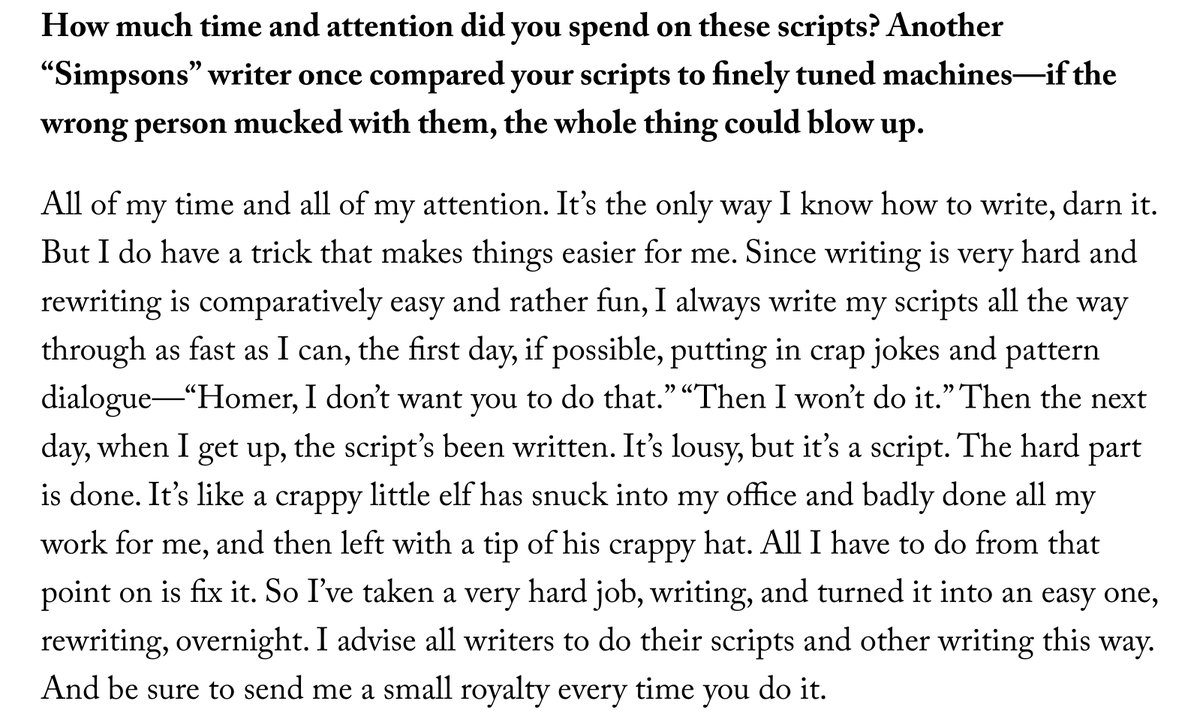
… which is practiced by the likes of Weapons (2025) and Barbarian (2022) writer-director Zach Cregger (via Room 243 Productions):
This is Zach Cregger’s approach to first drafts as a screenwriter. It’s called “elfing”. He’s right. ✍🏼 pic.twitter.com/MBGAkmpN5E
— Benjamin Luk (@benjaminluk) June 10, 2026
More lessons about how comedy series are written…
… and, more generally, about how a TV show gets made: