
Patiently beautiful.
‘The one that got away’ can be both escapist fantasy, and very real in how formative that fantasy can be. Where so many stories, and particularly films, indulge the escapist fantasy, Past Lives is instead interested in considering how we can acknowledge the weight of the fantasy within the real lives with which we move on.
We begin at the end, as childhood sweethearts Na Young / Nora (Greta Lee) and Jung Hae Sung (Teo Yoo) reconnect as adults – alongside Nora’s husband, Arthur (John Magaro). We then take a round trip through their lifelong journey toward this point. Through sensitive performances, captured in Shabier Kirchner‘s gorgeous cinematography, we learn where these three are now, and how they honestly feel about it.
It’s wild that this is the debut feature for writer-director Celine Song, who seems to be as interested in quiet vulnerability as she is confident that it is interesting for others to watch – and we’re all richer for it.
Past Lives never devolves into melodrama, but instead gives its characters time and space to gently express vulnerability with sincere, and in some moments enviable, emotional maturity.
Slate‘s Dan Kois describes the film as a gift of kindness, both to its characters and to its audience. In the current cinematic landscape, Past Lives might be considered the opposite of a multiverse movie: instead of visualising paths not taken, it sits with the ghosts of those paths in the here and now, rich with nuance and gentle ache for other people and the possibilities they represent. Ultimately, Past Lives is a patiently beautiful sonnet about simple, unadorned longing in circumstances which are no more and no less complicated than just life.
Update: I now have a response to the question I heard in a couple of places when Past Lives was still in theatres – ‘Is it as moving on a second viewing?’: your second time watching Past Lives should be with someone who’s watching Past Lives for the first time.
Further Viewing
“You’re just dealing with character, story, dialogue, blocking – the most fundamental parts of dramatic storytelling.” Celine Song explains to Kermode & Mayo how her ten years as a playwright informed her remarkably confident and evidently gifted debut as a film-maker, comparing and contrasting the two media as Buddhism to Christianity (oh, and the mechanics of storytelling on Mars):
Celine Song describes the way she and DP Schabier Kirchner ensured “longing gets built” into the very camerawork in Past Lives (via The New York Times):
The three stars were not allowed to touch during rehearsals, or even meet during zoom meetings, in order to create real-life first-time encounters that could be captured on film (via StudioCanal):
“The film lives and dies by this scene!” – it’s fascinating to see just how many kinds of work went into creating the film’s pitch-perfect ending (via FocusPulling.com):
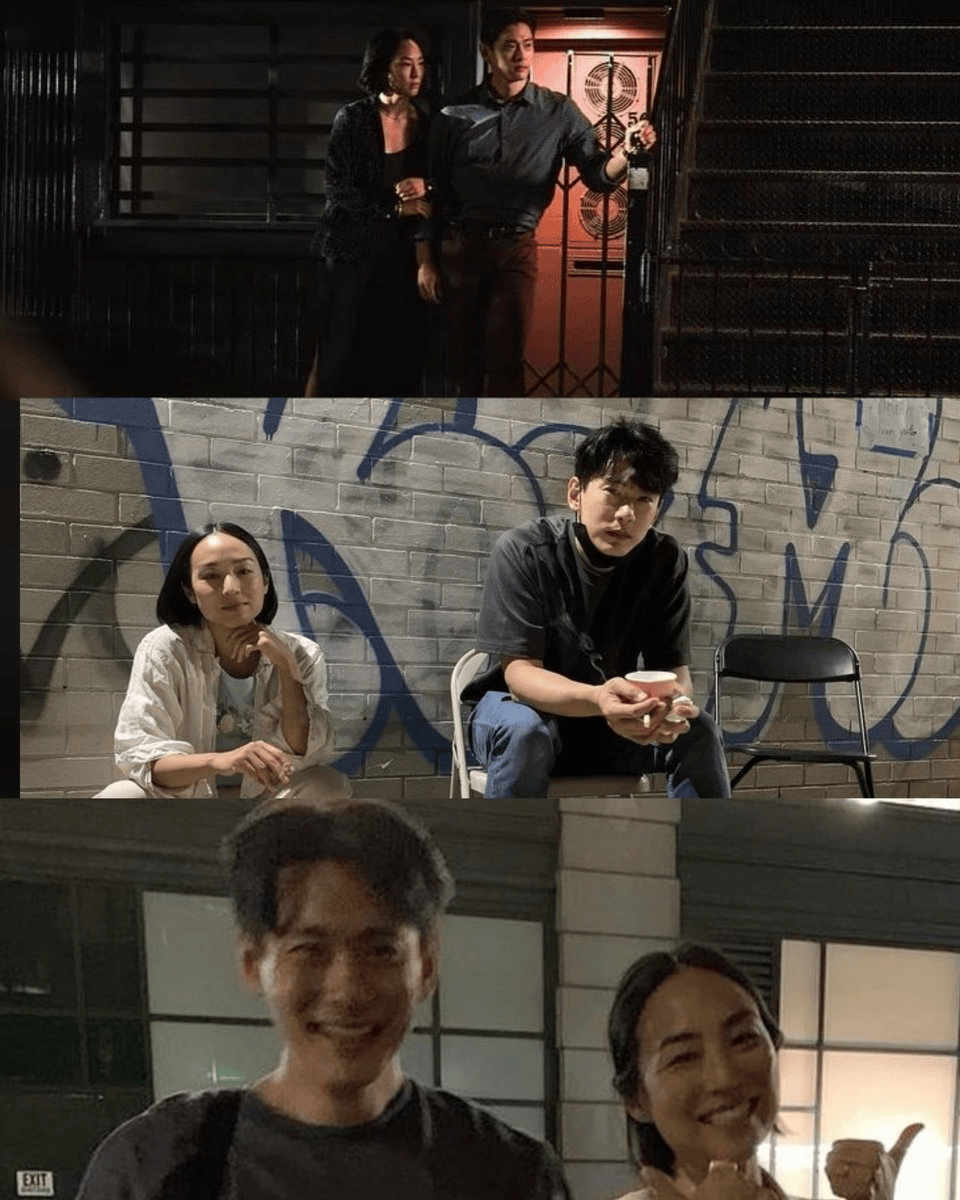
Greta Lee and Teo Yoo on the set of Past Lives:
While you may want to check out Celine Song’s follow-up next – which is, at the very least, quite different tonally…
… a more fitting pairing with Past Lives would be one of the other romantic masterpieces of this century, In the Mood for Love (2000):