
The sci-fi horror classic about how men fear impregnation.
Script
“One thing that people are all disturbed about is sex. I thought, ‘That’s how I’m going to attack the audience, I’m going to attack them sexually’,” recalls Alien screenwriter Dan O’Bannon. “‘And I’m not gonna go after the women in the audience, I’m gonna attack the men. And I’m gonna put it every image I can think of that I know will make the men in the audience cross their legs‘” (via CinemaTyler):
The crew is unisex and all parts are interchangeable for men or women
original Alien screenplay by Dan O’Bannon
As Helen Mirren recounts (via Masterclass)…
… the list of characters included in Dan O’Bannon’s original screenplay is explicitly non-gender-specific (from 3:16, via Alien Theory)…
… and, as a spectacular exception that proves the rule about film executives ruining films, it was the idea of Alan Ladd, president of 20th Century Fox, to cast a female to play Ripley (from 11:29, via Frame Voyager):
In Alien, while gender is irrelevant to its characters, sex is crucial to its gothic storytelling. Over the course of the film, the claustrophobia comes for Ripley in all manner of ways: stripping down the Nostromo to its escape pod; stripping down the crew to just Ripley; and Ripley herself finally stripping down, literally, only to discover the Xenomorph is sharing that intimate space with her. As the ‘final girl‘ toward the end of this slasher film, this moment is the film belatedly invoking a genre trope: it’s the first time that the camera’s gaze has becomes lurid, the first time the audience is invited – forced – to look at Ripley as a woman. It’s thematically designed to be simultaneously lewd and exploitative, it’s deliberately discomfiting, and that’s the point. It’s an idea Sigourney Weaver herself reinforced at the time. Yet it’s something even James Cameron, director of this film’s successful and beloved sequel Aliens (and a proprietor of his own ideas about the Strong Female Heroine™) seems to have misunderstood (via Alien Theory):
Design
Ridley Scott’s training as a designer enabled him to create his own storyboards, or ‘Ridleygrams‘ (via StudioBinder):
“The production felt that this was too directly reminiscent of female sex organs,” H. R. Giger journaled of his original design for the eggs opening, which he then modified from a slit to a cross – to appease “the Catholic countries”, of course (from 54:31):
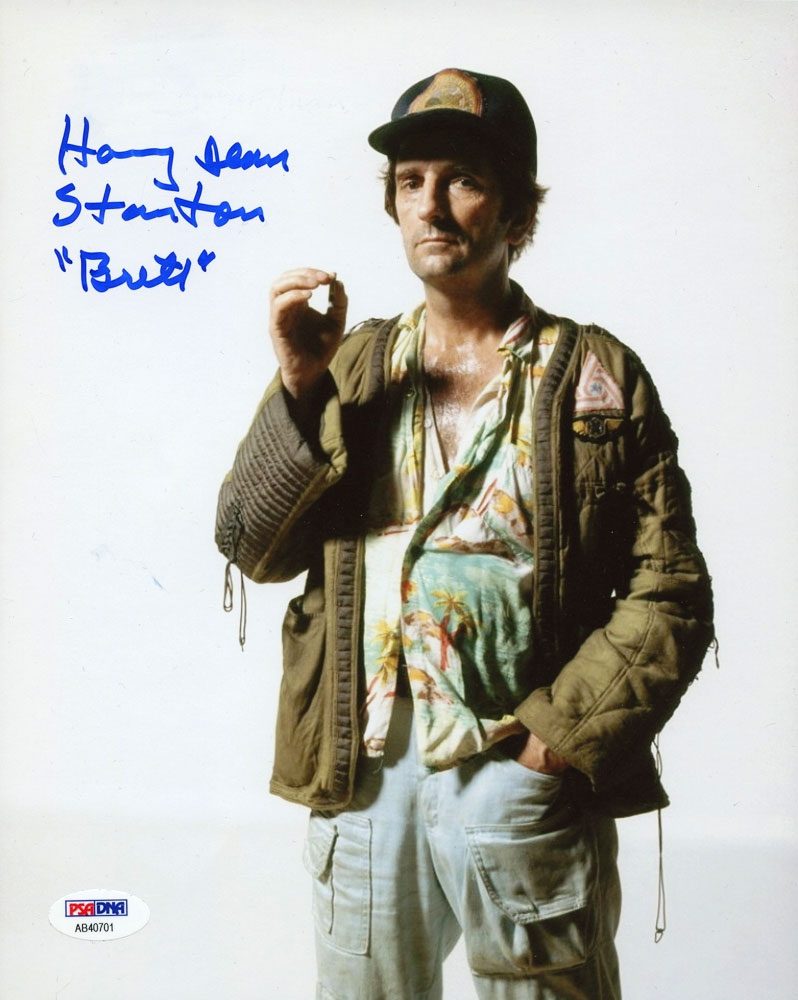
And, lest we forget, Alien was the first film to have a spaceship crew member look like this:
Cinematography
CinemaStix observes that Alien manages to create “unbroken” moments by shooting scenes with two cameras – one operated by cinematographer Derek Vanlint, the other by director Ridley Scott – rather than repeating action for single-camera capture. This allowed for the feeling that the characters “really are together, existing in the same space, at the same time”, and that the film-making was “capturing the raw truth of the moment“:
Further Viewing
CinemaTyler’s series ‘Making Alien‘ features detailed research, interviews with key crew, deleted scenes, and behind-the-scenes footage. Here’s the full playlist:
This behind-the-scenes playlist includes more on the film’s bonkers production and release, via interviews with the cast and crew, and deleted scenes (via JoBlo):
The original Alien screenplay by Dan O’Bannon, based on the story by O’Bannon and Ronald Shusett (free download):
Sigourney Weaver’s screen test for Alien:
Great footage of SIGOURNEY WEAVER in her screen test for Ripley in Alien (1979). pic.twitter.com/TosXYFlS6u
— All The Right Movies (@ATRightMovies) July 17, 2026
Footage from the Stan Winston Studio’s proof-of-concept test for James Cameron‘s sequel, Aliens (1986):
As only a few 🎟️ remain to our July 3 screening of James Cameron's ALIENS (1986) on 70mm 🎞️ (don't delay in obtaining your tickets: https://t.co/5k1VlE1pUP), we're resharing this early test footage of the film's third act star: the Alien Queen herself!
— Film at Lincoln Center (@FilmLinc) June 15, 2026
According to the Stan… pic.twitter.com/z6pB3wiQL6
The production of Ridley Scott’s other masterpiece from this period, Blade Runner (1982), was just as unusual – and tense: